Featured Post

Crucified Before the Foundation of the World

"Crucified before the foundation of the world." What does that mean? How could that even happen? Historians and archaeologists ta...

Wednesday, December 11, 2013

And It Was Night - John 13-Continued


It is easy to think of Jesus as calm and in total control of himself and the meal in the Upper Room. He had chosen the location and made the arrangements. He was the host for this meal with his disciples.

When he changes the course of things with the foot-washing, we immediately realize what was said by John in the first verse of the chapter. Jesus knew that this was a climatic event, but he seems to be trying to tell the Disciples in a gentle demonstration of love and compassion not to worry about the outcome, but simply to trust him.

John was writing several years after the event had happened, and he reflects on the scene with the wisdom of hindsight.  Judas was the one who would betray him and tonight was the night. John points out that Jesus was not blind to the facts and he was distressed about it.

Jesus knew that Judas was the betrayer, but the Disciples did not understand this or the significance of it. John was reclining next to Jesus and asked him the name of the betrayer, Jesus took a piece of bread and dipped it in sauce and handed it to Judas. “Jesus said, ‘What you are doing, do quickly.’”(Paraphrase) Judas left, but the disciples did not understand the significance of his departure yet. 

The Disciples were still looking for human explanations, and they thought Judas had gone on some errand concerning money.  Jesus said, “Now is the Son of Man glorified.” No angels appeared. No thunder clapped. But this was momentous in the mind and heart of Jesus. Betrayal was in the heart of Judas, and he was gone to accomplish his purpose.

Preachers’ sermons invest much time in exploring the last sentence in John 13:30b. And it was night. They may view it as reflecting the state of Judas’ heart. To others it may seem to signify the outlook for the world’s destiny without Jesus. 

John allows this to close the focus on Judas and betrayal. Now Jesus and the rest of the Disciples resume the final teaching and references to glory, departure and Peter’s denial.

See also the entry entitled "Do Your Feet Need Washing?" 

Thursday, December 5, 2013

Do Your Feet Need Washing? John13:1-11

The Upper Room discourse described in John 13-17 included a meal that Jesus shared with his Disciples. I have always read this and assumed that the meal was the Seder of Passover, but John 13:1 clearly states that this was before the Passover.  Perhaps Passover was on Friday, the day of the Crucifixion, but there are questions about that too. Jesus stated that he would be in the grave for three days and three nights. Using Thursday as the day of the Crucifixion would give the right time estimate with Sunday as the Day of the Resurrection.

John does not give the same details the synoptic gospels do of the supper. John refers to the meal and immediately describes the preparation for washing of their feet. I find it very helpful to recall the eating customs of the time. 

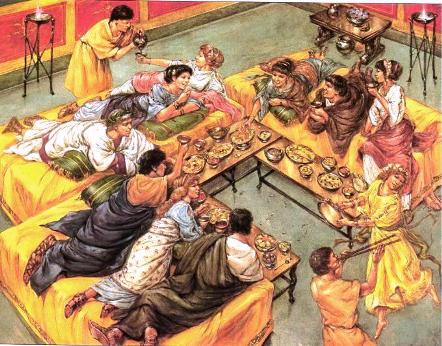
They reclined on couches leaning on the left elbow and extending their feet. This position made the foot-washing convenient and much less disturbing to the guests who were eating than sitting at a table would have been.  Jesus’ position was no longer the host and master but that of an obedient servant.

Nobody commented on this ceremony but Peter. His interchange with Jesus seems to be almost a rebuke to the Lord. First, he doesn't want Jesus to undertake this menial duty, but then he requests that he wash his hands and face too. Jesus corrects both these attitudes. 

This washing symbolizes daily communion with Jesus. Peter needed to go to Jesus for help, strength, and forgiveness whenever he was exposed to contact with the world, and Jesus offers us this constant refreshing.  

On a continuing and constant basis, Christians are invited to seek Jesus for forgiveness and encouragement in daily life and ministry.  We are to remain always yielded and humble. 

Peter seems to have thought he was above needing this service, but Jesus told him there was more to this than Peter understood at the time.

 Jesus had foreknowledge, but He did not control people’s behavior.  He knew Judas had would betray Him, but he did not interrupt the plan Judas had made. 

He proceeded with the foot washing and did not exclude Judas. I wonder what Judas’ emotions were at this critical time. Did he agonize when Jesus performed the humble task of cleaning his feet? Did he recognize this as an opportunity to repent? Or was his heart hardened to the path he had chosen?

Jesus in the Upper Room discourse spoke urgently to the disciples emphasizing the importance of this last chance at teaching them before the Crucifixion because He knew they would be scattered and their faith would be tested. 


He was very tense as shown in his language.  His speech was urgent and stressful.  He wanted to be sure they were committed to Him, but that was yet to be seen.  His nature was compassionate, but his need was immediate.  There was no Plan B.  If this was not successful, salvation would never happen.

Sunday, October 13, 2013

Who Wrote the Bible?

I'm not sure who wrote the Bible.  Some books are named for a person who was the main character.  I couldn't tell if they are autobiographical or if they are a record of events from an observer.  They are generally written in the third person until you get to the New Testament.  The book of Joshua and 1& 2 Samuel fit this pattern.  The first five books are called the Books of Moses, or sometimes they are called the Books of the Law. 

Some books are believed by scholars to have more than one author or to have been edited by others at a later time.  Many of the books are believed to have been written at a much later time than the events they record. 

There are extant books that were not included in the Biblical cannon but seem to have been composed and available at the same time as those that are.

 As believers we pretty well accept the Bible as the Word of God and assume that he provided for recorders to write what he wanted included. 

The Bible is a collection of stories about people and we are required to understand the lessons they teach by the way they lived and apply the truths to our own circumstances. Sometimes there are many ways to read and interpret each story.  Different traditions and denominations apply different rules and applications to characteristics and actions. 

The Bible is very complicated. It reveals the love and mercy and judgement of God. This is not a simple subject. It must be by definition, complex and intricate. I guess for something so important and far-reaching, I don't want it to be simple and uncomplicated. I like the fact that it is difficult to understand and time-consuming to read. I want it to have more than I will ever be able to comprehend. I want to spend the rest of my life and my energy exploring it depths.   

As for who wrote the Bible, If I find any clues, I'll let you know.

Friday, September 13, 2013

Knowledge of Good and Evil

Knowledge of Good and Evil rests in God, but he has given humans some insight on the problem. In the Garden of Eden this knowledge was imparted by consuming the fruit of the Tree which Adam and Eve were forbidden to do.  Understanding good and evil seems like a basic attribute of being human, but God wanted people to seek him instead of making independent choices and decisions.

After they ate of the fruit, they recognized their nakedness and their disobedience and sought to hide from the presence of God. Even the thicket and foliage did not protect them. God saw them and knew their state. Being naked was not the sin, but no one can stand before God having committed sin and endure exposure. Adam and Eve used the large leaves of the fig tree to cover their bodies, but leaves dry up or wilt and lose the ability to cover pretty soon. Their exposure was profound.

God is not at a loss for words nor does he search frantically for a solution, but he does require a sacrifice. The skin of animals provided a more appropriate covering for Adam and Eve, but they knew the extent of their sin by the slaughter required to make them acceptable to God, and they suffered eviction from Eden 

The sin released in the heart and mind of man and woman in Eden has kept pace with technology and invention so that now we have evil on a grand scale. War and genocide reveal evil as an attribute of nations not just individuals. Can we recall the sin naturre and reframe mankind's goals to eliminate this tendency? 

God provided that in the person of Jesus Christ. It required a sacrifice just like the covering of Adam's sin. It also required a continuous living under the shelter of his provision. We  are still revealed as naked sinners and repeat the same mistakes when we fail to obey his instructions. 

Wednesday, September 11, 2013

Where Is Jeremiah Today?

Jeremiah 18:1-6 tells the story of God's message to Jeremiah as he watched the potter shape a vessel. The lesson is straightforward: God can craft the clay, but, if it is flawed, he can also reshape it to suit his purpose . Applying the lesson to Israel is easy enough, but the story doesn't end there. 

The guilty of Judah and Jerusalem heard Jeremiah's message but instead of the repentance God called for, they attacked Jeremiah and Jeremiah returned to God to complain. 

In bright light of day when all the people could hear Jeremiah's prophesy against them for the evil in their hearts, Judah and it's capital city Jerusalem did not repent or humble themselves. Actually they responded much as people do today. Instead of seeking forgiveness, they attacked the messenger. 

Jeremiah goes to God to complain about their response. "They have dug a pit for m," he says. Now Jeremiah goes on the offensive with God against the attack. He calls on God to leave the women childless widows and let the young men be killed with the sword.  In his defense against the unjust accusations against him, Jeremiah has become violent, too. Where will the sin end?

God told Jeremiah to take a clay jar to the Valley of Ben Hinnon and there he was to smash the jar as an illustration to the people of the coming destruction of Judah and Jerusalem. The clay was no longer pliable in the potters hands. When it became hardened and ridged, destruction was God's judgment, and the hardness of their hearts brought destruction on them. God called them a stiff-necked people. 

Not only Israel and Judah, but all nations that have once received light from God and blessing on their land, stand in jeopardy of judgment. It is still true. 

Sunday, June 23, 2013

Yael's Victory

Heber was not an Israelite, but he was a kinsman of Moses wife. He was married to Jael and they lived as nomadic herdsmen. He pitched his tent near Kedesh. The habits and culture of the nomadic herdsmen are singular to this group. While they did live in tents which had the capability of mobility, they often stayed in one location for 2 or 3 years. 

The tents were large with multiple rooms. They were made of heavy woolen fabric and leather. The women were responsible for erecting the tents when they were moved. The women's rooms were their private sanctuary and strangers were not invited there. Finding a man in a woman's rooms was justification to kill him. She would have been executed if she invited him there.

Many commentators criticize Jael's defense of herself. It was indeed a brutal and violent act; however in her defense, I feel we should look at 20 years of torment Israel suffered under Jabin's rule and Sisera's iron chariots. Yael would surely have become a slave when 
Sisera's army divided the spoils if he had won.

Judges 5 contains one of the oldest extant examples of Hebrew poetry. It is the victory song of Deborah and Barak describing the battle and Jael's act of self defense. The story includes the storm which contributed to Sisera's sound defeat. The final scene describes Sisera's mother anticipating his return.

Deborah led Israel in peace for 40 years. Read the whole story in Judges 4 and 5.

Saturday, June 22, 2013

Deborah-Judge of Israel

Debora is one of the renowned women of the Bible, and her story is quite remarkable. She is the only female leader of Israel. Deborah was a prophetess and the wife of Lappidoth; perhaps she had won renown as a prophet and that elevated her to the position of leadership. The Bible does not elaborate about how she became the leader of Israel.


She held court under the Palm of Deborah between Ramah and Bethel in the hill country of Ephraim, and the Israelites went up to her to have their disputes decided.(Judges 4:5)
                                   
Ehud was the previous Judge and he died leaving Israel without leadership. Israel committed evil in the sight of God and God allowed Jabin, a Canaanite king, to punish them for their sin. Under the command of Sisera, Jabin's army tormented the Israelites for 20 years. When the people plead with God for mercy, he commanded Deborah to take action.
  
Deborah was now acting as Judge. In that time the Judge was also the military leader. She summoned Barak from Kedesh to be her commander. He agreed, but he did show hesitancy saying, "If you go with me, I'll go, but if you don't, I won't either." She agreed, but she told him that because of this he would not receive honor for defeating Sisera: that would go to a woman.

She called for volunteers from the tribes of Zebulon and Napthali. I questioned why she didn't call for volunteers from the whole country, but maybe, because these two tribes were close to Sisera's headquarters, they had more reasons to hate and fear him. The response was good They now had an army of 10,000 men. 

Sisera's  forces included 900 iron chariots. These were the tanks of the time. 


The chariot carried two soldiers: one controlled the horses and one carried a weapon, either a bow or a sword. When Israel prepared for war, their only weapons were homemade ones. Sisera commanded trained regiments. It didn't look good for Israel, but don't discount them: They did have God on their side.

Barak's men positioned themselves on Mount Tabor in readiness for battle. Sisera was told that Barak was assembling forces so he called his men and chariots to thtpe plain in the Kishon Valley. At the call to battle the forces of Deborah and Barak ran down the side of Mount Tabor to confront the foot soldiers and iron chariots of Sisera. Israel had the advantage since they had the high ground. They came down the side of the mountain in a flood. God had given them an advantage: A storm had soaked the ground allowing the heavy, iron chariots to sink in the mud. The thousands of volunteers overran the helpless chariots killing the soldiers caught in the mire and sludge at the foot of the mountain. Sisera evaded them and ran from the battlefield to find refuge in the tent of Jael, the wife of Heber the Kenite.
                                             To  Be Continued